Restoring without erasing: how to intervene in Málaga's historic centre
Intervening in a building in Málaga's historic centre is not the same as constructing a new one. The rules are different, the materials are different, and the fundamental question is different: not "how do I want it to be," but "what is already here and how can I improve it without destroying it?"
Málaga's historic centre concentrates one of the richest and most battered architectural heritages in southern Spain. Rich because the city has been inhabited continuously for more than three thousand years, with each era leaving superimposed layers of architecture: Roman, Moorish, Christian medieval, Baroque, Modernist, Rationalist. Battered because the neglect of the second half of the twentieth century, followed by the speculation of the boom years, left an urban fabric in poor shape: façades with crusts of plastic paint over original render, openings altered without any logic, anodised aluminium joinery where there was once painted timber.
Working in that context demands, above all, learning to read what is already there. A rigorous survey of the existing façade — materials, layers, pathologies, original and modified openings — is the first real work of the project. Everything that follows depends on that knowledge.
The regulatory framework: what is and isn't permitted
Málaga's historic centre has been declared a Site of Cultural Interest (Bien de Interés Cultural) in the category of Historic Ensemble. This means that any intervention on façades visible from public space requires authorisation from the Junta de Andalucía's Cultural Affairs Department, in addition to the municipal building permit. The process is slower and requires more documentation than a standard construction project, but it is perfectly navigable if the project is well argued.
The Special Protection Plan for the Historic Centre (PEPCH) classifies buildings according to different levels of protection: integral, structural, environmental and unprotected. For each level, the regulations establish which elements are untouchable, which may be modified with conditions, and which may be freely replaced. Knowing that classification from the outset avoids unwelcome surprises mid-project.
"The best restoration project is one where, when it is finished, it seems as if it was always like that. No visible scars, no stylistic impositions, no forced nostalgia."
The language question: mimicry or contrast?
This is the oldest architectural debate in restoration work and probably the one that has generated the most discussion. Should a contemporary intervention in a historic building imitate the language of the original, or should it be recognisable as new? The answer of the Venice Charter — the international reference document on heritage conservation — is clear: new interventions must be legible as such, so as not to falsify the history of the building. But that does not mean they must be aggressively modern.
In our practice, the position that has worked best is maximum fidelity to the original construction systems and materials, combined with complete freedom in the new elements that are introduced. If a cornice needs to be rebuilt, we rebuild it using the same mortars, the same profiles and the same geometry as the original. If a new volume needs to be added, we add it with complete formal clarity — no disguise — but with a choice of materials and a scale that respects the context.
Materials in the restoration of historic façades
Lime mortar is the restoration material par excellence in Málaga's historic architecture. The traditional renders of the city are executed in natural hydraulic lime — a material that breathes, allows moisture to evaporate from the walls, and is chemically perfectly compatible with the rubblestone or brick masonry it is applied to. Portland cement mortars, which were used extensively in the 1970s and 1980s to repair historic façades, are incompatible with lime: they are stiffer, impermeable and harder, which creates tensions that end up detaching the original wall surfaces.
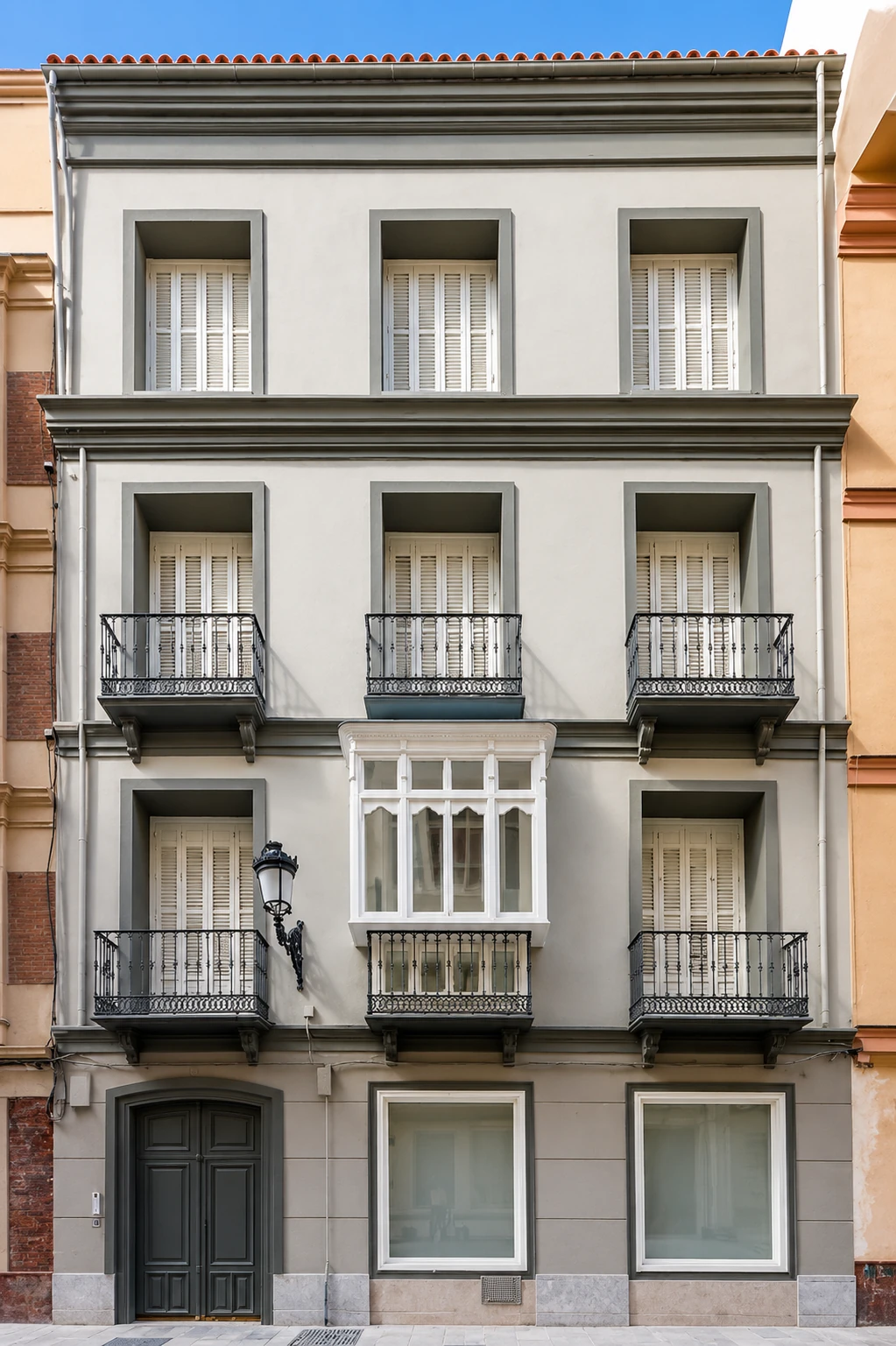
The restoration of the façade of El Museo Apartamentos, in the heart of Málaga's historic centre, confronted us with this problem: the lower half of the façade had been covered in cement render during the 1980s. The stripping work — removing the cement without damaging the original masonry — was slow and artisanal, carried out by hand. But it was essential to allow the new lime layer to bond correctly and for the wall to breathe properly again.
Painted timber joinery is the other great identifying element of Málaga's historic centre façades. Balconies with painted timber joinery in bottle green, pearl grey or off-white are a defining feature of Málaga's urban landscape, worthy of preservation. Today timber joinery with high-durability treatments can last 25–30 years with virtually no maintenance, removing the economic argument in favour of aluminium.
The patina of time as value
One of the most common mistakes in the restoration of historic buildings is an obsession with returning the building to a state of original perfection that probably never existed. Historic buildings that have survived several centuries carry in their walls the marks of that time: repairs, extensions, successive modifications. Those marks are information — they are the material history of the building and of the city.
A restoration that erases all those traces to leave the building looking as if it had just been completed in 1880 is not a restoration: it is a forgery. The architect's work is to distinguish which marks are valuable — and should be preserved or at least documented — and which are damage that must be repaired because it compromises the integrity of the building or its use. Not every patina is beautiful, and not every form of deterioration constitutes heritage.
The interior: the other face of the intervention
The restoration of a building in the historic centre does not end at the façade. In most projects we undertake in this context, the façade is only the visible part of a deeper intervention that affects the structure, the installations and the internal layout. Buildings from the nineteenth century and early twentieth century — which predominate in Málaga's historic centre — have timber floor structures, completely obsolete services, and layouts that respond to ways of living that no longer exist.
The technical challenge is reconciling the demands of contemporary use — acoustic and thermal insulation, air conditioning systems, accessibility, energy efficiency — with the preservation of historically valuable elements: exposed timber beams, hydraulic tile floors, decorative plasterwork, original interior joinery. Each project is a different puzzle, because every historic building has its own logic and its own singular qualities.
What all of them have in common is the need to build trust early with the administrations involved: with the municipal heritage officer, with the officials of the Junta de Andalucía. A restoration project in the historic centre that does not have the backing and cooperation of the relevant technical officers is one that has every chance of becoming a long, costly and frustrating process. Heritage architecture is not only a technical discipline: it is also, inevitably, a discipline of dialogue.